
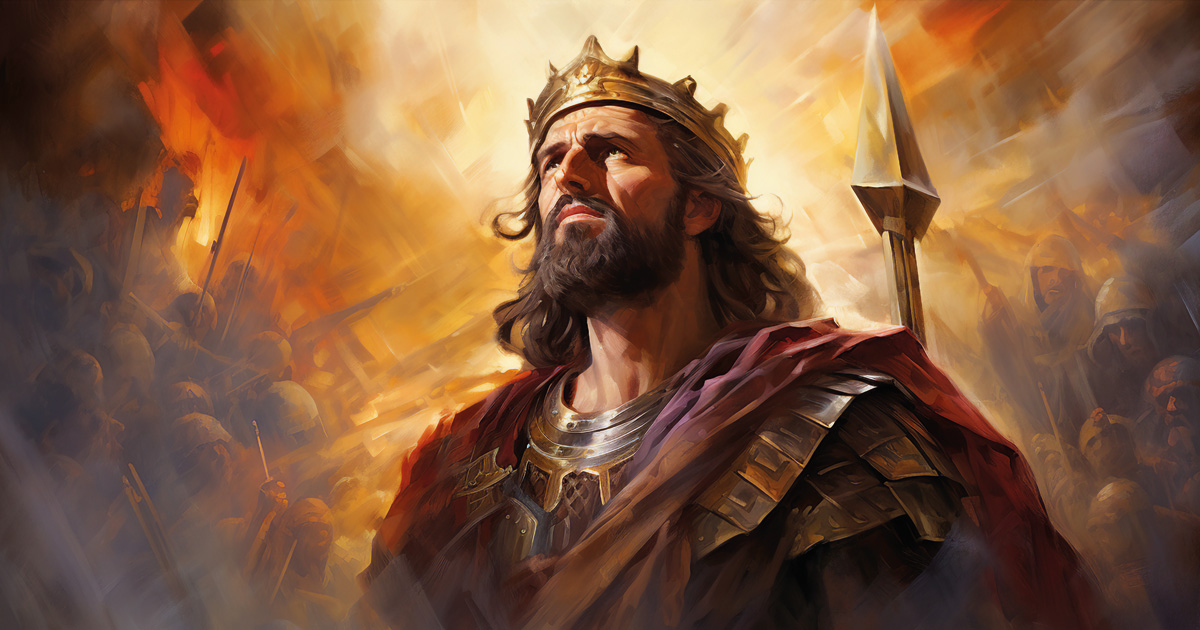
A Man After God’s Own Heart
Introduction
In boardrooms, investment portfolios, and leadership circles, success is often measured by influence, scale, and financial performance. The world rewards vision, strategy, and execution. Yet history—and Scripture—quietly ask a deeper question:
What is the condition of the heart behind the success?
Some of the most powerful figures in history left behind remarkable legacies—innovations, wealth, institutions. Yet the Bible presents a different standard of greatness. It speaks of a man not defined by his net worth, military success, or political dominance, but by something far more rare:
A man after God’s own heart.
This is not merely a spiritual compliment—it is a leadership paradigm.
When we examine the life of David, we are not just studying a shepherd turned king; we are encountering a model of leadership rooted in alignment with divine purpose rather than personal ambition.
Human effort, achievement, and performance—even at their highest level—can never substitute for total dependence on God.
In a world driven by metrics, KPIs, and quarterly returns, this truth confronts us:
- You can build a billion-dollar enterprise and still lose your soul.
- You can lead thousands and still be internally misaligned.
- You can succeed publicly and fail eternally.
Is your success aligned with the heart of God—or merely driven by the ambitions of self?
When God Writes Your Epitaph
An inscription on a grave marker is called an epitaph. An epitaph is a short piece of writing—either in prose or in verse—that honors or remembers a person who has died.
One epitaph was written in memory of the great English polymath Isaac Newton:
“Here lies that which was mortal of Isaac Newton. Who by a strength of mind almost divine, and mathematical principles, explored the motions and figures of the planets, the paths of comets, the tides of the ocean; and disclosed the structure of the universe.
He vindicated by his philosophy the majesty of God and the glory of man.
Here lies the body of Isaac Newton, a man with an intellect closer to the divine than any human before him.”
Of Benjamin Franklin, this epitaph reads:
“The body of B. Franklin, Printer;
Like the cover of an old book,
Its contents torn out,
And stripped of its lettering and gilding,
Lies here, food for worms.
But the work shall not be lost;
For it will as he believed
appear once more
In a new and more elegant edition.”
But perhaps the most remarkable epitaph of all is the tribute written about King David—not by a human being, but by God Himself.
In Acts 13:22 we read these words:
“I have found David the son of Jesse, a man after mine own heart, which shall fulfil all my will.”
What an extraordinary testimony. God honored David greatly by making him a foreshadowing of his descendant—the Savior of the world. There was something in David’s heart—something he had learned about God—that made him fit to stand in the lineage of Jesus Christ.
At first glance, it almost seems surprising that God would choose a shepherd boy to lead His people as their king. As a young man, David may have appeared shy and simple—what we might call a country boy with little worldly sophistication. Yet he was entrusted with the enormous responsibility of ruling a nation from its capital.
We might wonder what God was thinking when He chose such a king. And yet we might ask the same question about ourselves: Why would God call you to His kingdom at such a time as this?
Perhaps you sometimes feel uncertain among God’s people. You may wonder about your standing with God and within the body of Christ. At times you may even struggle with assurance of salvation.
Why would God call you now?
To answer that question, we must understand the deeper significance of David’s call to the kingdom.
Saul: The King the People Chose
David’s predecessor was King Saul—the king the people chose for themselves because they did not fully trust God’s promise to lead them.
God had said that He Himself would be their King. But the people wanted someone they could see, just like the nations around them. When the prophet Samuel heard their demand for a king, he was deeply troubled. The people wanted someone tall, impressive, and powerful—and Saul appeared to be exactly that kind of man.
But the Lord reassured Samuel:
1 Samuel 8:7-8 (KJV)
7 And the Lord said unto Samuel, Hearken unto the voice of the people in all that they say unto thee: for they have not rejected thee, but they have rejected me, that I should not reign over them.
8 According to all the works which they have done since the day that I brought them up out of Egypt even unto this day, wherewith they have forsaken me, and served other gods, so do they also unto thee.
The people were not merely asking for political leadership. They were rejecting God’s direct rule.
And we know how the story ended.
The result of their choice was disaster. The honor and praise given to Saul eventually went to his head. Instead of depending on the Lord, he began to trust in his own strength and authority. Suspicion filled his mind. He constantly feared that someone would overthrow him and take his throne.
In his desire to maintain control, he became increasingly tyrannical—much like the kings of the surrounding nations. Under Saul’s leadership, the nation suffered from a lack of spiritual guidance. There was little true focus on God.
Ellen White wrote:
Saul had been after the heart of Israel, but David is a man after God’s own heart.
The Signs of the Times, June 15, 1888, par. 10
It soon became clear that a change was needed—a change in leadership, a change in the king.
But how would God bring about that change?
In political terms, we might call it a coup d’état. Yet God’s method would be very different from the methods of human revolutions.
During Saul’s reign the nation was becoming increasingly worldly. The knowledge of God was fading, and His principles were being neglected.
How would God restore His kingdom?
Whenever a nation experiences revolutionary change, there is always danger. Chaos can follow. People may begin doing whatever seems right in their own eyes.
Yet Israel’s true King had always been God Himself.
What God needed was not simply another political ruler. He needed someone who would recognize His authority—someone who would lead the people while remaining fully submitted to the Lord.
That man was David.
A Man After God’s Own Heart
David is the only person in Scripture whom God specifically calls “a man after His own heart.”
We find this statement both in the Old Testament and in the New Testament.
In 1 Samuel 13:14 (KJV) we read:
… the Lord hath sought him a man after his own heart, and the Lord hath commanded him to be captain over his people…
And later, Paul confirms it:
In Acts 13:22, he declares:
“I have found David the son of Jesse, a man after mine own heart, which shall fulfil all my will.”
This reveals a deep and personal connection between God and David.
It raises an important question:
What was in God’s heart that was also in David’s heart?
And even more personally:
How can we become people after God’s own heart?
The Shepherd Boy
Before he became king, David was a shepherd boy in the town of Bethlehem.
Bethlehem lay in the hill country a few miles south of Jerusalem. Its name means “house of bread,” likely because the surrounding land produced abundant grain.
Bethlehem was already an ancient town even in David’s day. The patriarch Jacob had once lived there, and nearby Rachel was buried. It was also the home of David’s great-grandparents, Ruth and Boaz.
And a thousand years later, Bethlehem would become the birthplace of Jesus Christ—the descendant of David—was born in human flesh to save His people from their sins.
As the prophet Micah foretold:
Micah 5:2 (KJV)
But thou, Bethlehem Ephratah, though thou be little among the thousands of Judah, yet out of thee shall he come forth unto me that is to be ruler in Israel; whose goings forth have been from of old, from everlasting.
David was the youngest son of Jesse, who had eight sons. As the youngest, David likely spent much of his youth caring for his father’s sheep.
While tending the flock in the fields and hills, David developed skills common to shepherds. He could run swiftly and sling stones with remarkable accuracy.
But David was more than an athlete. He was also a musician and a poet.
As he watched the beauty of nature and listened to the sounds of creation, he began composing songs of praise to God. Many of those songs would later become the Psalms.
He also treasured the spiritual instruction he received from his father Jesse and from the prophet Samuel. He stored God’s Word in his heart.
Lessons Learned Under the Night Sky
The work of a shepherd did not end when the sun went down. Sheep had to be guarded through the night from predators. Hungry wild beasts could come and destroy the flock.
For that reason, David sometimes had to stay awake through the night watching over the sheep, protecting and guarding them. It was not always a pleasant task, yet we never read that David complained about it.
Often David stayed awake beneath the stars watching over the flock.
During those quiet nights he studied the heavens and reflected on the greatness of God.
From those experiences came the words of Psalm 8:
Psalm 8 (KJV)
1 O Lord, our Lord, how excellent is thy name in all the earth! who hast set thy glory above the heavens.
3 When I consider thy heavens, the work of thy fingers, the moon and the stars, which thou hast ordained;
He also wrote:
Psalm 8:4 (KJV)
4 What is man, that thou art mindful of him?
Even as a young shepherd, David understood that God’s glory could be revealed in human life.
The Heart of a Shepherd
When God was working in David’s life, He was establishing real strength within him.
This strength became evident on several occasions when David was guarding his sheep at night. Fierce wild animals sometimes prowled around the flock.
On one occasion, a lion seized one of the lambs and began dragging it away.
David could have reasoned with himself, “It would be very dangerous to interfere with that lion. After all, it is only one lamb. Perhaps I should let the lion take it.”
But David did not think that way. He was a shepherd, responsible for every sheep in the flock. That lamb was precious to him. So he pursued the lion in order to rescue it.
David was willing to risk his life to save that one little lamb. He had the true heart of a shepherd. His only thought was that the lamb was in danger and needed to be saved.
God was David’s strength. Even though the lion was stronger than he was, God was stronger still. Trusting in the strength of the Lord, David pursued the lion with only his shepherd’s staff. He struck the lion until it dropped the lamb. When the lion turned on him, God gave David the strength to overcome it, and the lion was slain.
On another occasion, a bear attacked the flock. Again David trusted in the strength of God, pursued the bear, and defeated it just as he had the lion.
Through experiences like these, the young shepherd learned to see the hand of God at work in his life.
Abraham, Isaac, Jacob, and Moses had all been shepherds. David studied the history of these men and learned from their lives. He realized that human beings are like sheep—dependent, vulnerable, and in need of guidance.
From this he learned a great truth: God Himself is the great Shepherd.
God is the One who feeds His flock, who guides them, and who leads them beside the waters of life.
As David cared for his sheep, he felt compassion for their helplessness.
He carefully led them to the best pastures and the easiest paths. And as he did this, he began to realize something profound: the Lord was guiding him with even greater love and wisdom.
The shepherd boy was learning the ways of the Lord.
The Good Shepherd
What David learned while tending his sheep pointed forward to a far greater Shepherd.
Jesus Christ came into this world as the Good Shepherd who seeks and saves the lost.
In the parable of the lost sheep, Jesus reveals something remarkable: the sheep does not search for the shepherd—the shepherd searches for the sheep.
Many people imagine that God is hiding from us and waiting for us to find Him. But the Bible teaches the opposite.
God is seeking us. Salvation begins with God’s initiative, not ours.
Christ came to seek and to save that which was lost.
When Jesus shed His blood for the world, He tasted death for every human being.
Scripture says:
1 Timothy 4:10 (KJV)
For therefore we both labour and suffer reproach, because we trust in the living God, who is the Saviour of all men, specially of those that believe.
And:
1 John 2:2 (KJV)
And he is the propitiation for our sins: and not for ours only, but also for the sins of the whole world.
Christ’s sacrifice is not merely a possibility—it is a gift already given.
The Gift Already Given
Sometimes we imagine that Christ does nothing for us until we first take the initiative—until we believe or obey.
But the gospel teaches something far greater.
Christ has already acted.
His sacrifice is not merely provisional; it is effective. Through His death He has purchased our present life and everything we possess—and far more.
He has purchased eternal life and given that gift to us in Himself.
Yet we still retain the freedom to reject that gift.
The problem is not that God is unwilling to save us. The problem is that human beings sometimes resist His grace.
The spiritual paralysis of apathy often comes from thinking of Christ as though He were a bank that does nothing for you until you make a deposit.
But the truth is the opposite.
Christ has already deposited eternal life into your account.
Faith simply accepts the gift.
If anyone is saved, it is because of God’s initiative.
If anyone is lost, it is because he resisted that grace.
The Motive of Love
Why is this truth so important?
Because fear is not a strong enough motive to prepare people for the second coming of Christ.
Fear may awaken someone—but it cannot sustain a life of devotion.
There is a higher motive: love.
As Ellen White wrote:
The shortness of time is frequently urged as an incentive for seeking righteousness and making Christ our friend. This should not be the great motive with us; for it savors of selfishness. Is it necessary that the terrors of the day of God should be held before us, that we may be compelled to right action through fear? It ought not to be so.
Jesus is attractive. He is full of love, mercy, and compassion. He proposes to be our friend, to walk with us through all the rough pathways of life. He says to us, I am the Lord thy God; walk with Me, and I will fill thy path with light.
Jesus, the Majesty of heaven, proposes to elevate to companionship with Himself those who come to Him with their burdens, their weaknesses, and their cares. He will count them as His children, and finally give them an inheritance of more value than the empires of kings, a crown of glory richer than has ever decked the brow of the most exalted earthly monarch.
Lift Him Up (1988), p. 98.3
Love awakens the heart.
When we truly see Christ’s sacrifice, our attitude toward God changes completely.
We are no longer enemies—we become friends of God.
The Cross and the Death of Self
The great problem behind all suffering and evil in the universe is the problem of self.
The entire conflict between good and evil can be summarized in one question:
Will self rule, or will God rule?
Jesus revealed the solution.
Philippians 2:5-8 (KJV)
5 Let this mind be in you, which was also in Christ Jesus:
6 Who, being in the form of God, thought it not robbery to be equal with God:
7 But made himself of no reputation, and took upon him the form of a servant, and was made in the likeness of men:
8 And being found in fashion as a man, he humbled himself, and became obedient unto death, even the death of the cross.
Matthew 16:24 (KJV)
Then said Jesus unto his disciples, If any man will come after me, let him deny himself, and take up his cross, and follow me.
The cross represents the surrender of self and the acceptance of God’s will.
Yet many people come to God only because they want their problems solved or their lives made comfortable.
But the call of Christ is deeper than that.
If we want to become people after God’s own heart, we must take our focus off ourselves and place it on the cross of Christ.
This is the way of self-denial. It is the way of crucifixion.
And yet, paradoxically, it is also the way of true joy.
When the old self is crucified with Christ, the power of sin is broken.
Then the mind of Christ lives in us.
Christ emptied Himself so that God could be revealed in human flesh.
And when this same mind is in us, we too are emptied of self so that God may be revealed in our lives.
Then it is no longer self that lives within us.
It is God working through us.
Conclusion
In the end, every leader leaves behind an epitaph.
Not necessarily one carved in stone—but one written in influence, in people, in decisions, and ultimately… in eternity.
Isaac Newton was remembered for unlocking the laws of the universe.
Benjamin Franklin for wisdom, innovation, and foresight.
But David?
He was remembered by God Himself with words no level of success can purchase:
“A man after My own heart.”
This is the highest evaluation a human life can receive.
And it forces a sobering reflection—especially for those entrusted with power, capital, and influence:
- When your company grows, does your dependence on God grow—or shrink?
- When your wealth increases, does your generosity expand—or does control tighten?
- When pressure rises, do you compromise—or stand anchored in principle?
You are not saved by your performance—even at your best.
You are sustained, transformed, and led by Christ alone.
The world’s systems—economic, political, even religious—will ultimately be tested.
And many will fall not because they lacked intelligence, but because they lacked surrender.
In business terms, we might say:
- You can scale operations—but not righteousness.
- You can leverage capital—but not grace.
- You can optimize systems—but not the human heart.
Only Christ can do that.
And here is the paradox that defines true greatness: The most powerful leaders in God’s kingdom are those who no longer live for themselves.
One day, the metrics will disappear.
- No balance sheet will matter.
- No valuation will stand.
- No title will remain.
Only one question will endure: Did your life reflect the heart of God?
The invitation is extended today: Not to abandon success, but to redefine it.
Because in the end, God is not looking for the most powerful leaders. He is looking for those whose hearts are fully His.
